The GHRA has an extensive photo collection of Guelph, and surrounding areas, in an effort to showcase Guelph history, we have created this photograph library to showcase some of our collection.
Below are albums of historical photos, modern photos taken by our group members, as well as past GHRA events.

6167 and 6218
6167 and 6218 in Hamilton, Ontario, being prepared for their trip later in the day. This is 6167's final day of operation, September 27, 1964. Bruce Lowe photo.

CP 1835
The crew of CP 1835 are climbing aboard their locomotive at Guelph junction to build their train for Guelph. July 1990. Bruce Lowe Photo.

CNR Guelph Junction
Looking North at Alma Street in Guelph

Guelph CPR station
Bruce Lowe took this photo of the former CPR Guelph Station in Guelph. The station was supposed to be dismantled and moved to Cambridge to be part of a railway museum, but the plans for that museum never came to fruition.

CN 1240 in Guelph
The equipment for trains 160/161 lays over at CN Guelph Junction in siding XW36 on a cold weekend in January, 1975. 160/161 was a Guelph-Toronto and return passenger train, departing Guelph at 0625h, and returning at 1905h. On this day the train's power is GMD SW1200RS 1240, built by GMD in 1956, would be retired in 1989 and sold to Relco as their 1283, disposition afterwards unknown. Behind the train is the Guelph Twines plant, having been taken over in 1972 after moving to Guelph from Brantford. The company still operates from this building today. January 1975. Bruce Lowe Photo.

September 1972: Work Train In Guelph
A Canadian National Work train sits along Edinburgh Road in Guelph. In the background is the original St. Joseph's Hospital. Bruce Lowe Photo.

Waterloo-St.Jacobs Excursion in Guelph
The Waterloo-St. Jacbos railway ran a few excursions in Guelph in the 1990s. This is one of those excursions passing the limestone cliffs south of Guelph. Bruce Lowe Photo.

Industrial Meet
April 1980. Taken from the cab of GMD SW8 7170 on the CN Guelph Yard job, a meet is seen with the CP yard job, led by MLW S3 6529. CP is seen proceeding up the grade from Dawson Road towards Maple Leaf Mills, today Traxxside Transloading. At this time the facility only had one spur on the property. CN 7170 sits clear of the South Industrial main on the lead to National Standard; today Traxx 5 and 6; the Traxside glass tracks. Both locomotives would be off the roster in less than a decade. The facility pictured is Court Galvanizing Ltd. Bruce Lowe Photo.

6167
6167 on one of it's excursion trains. If you look closely, this is the number plate the GHRA has in our collection.
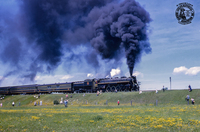
6167 Eastbound From Lindsay
The fireman aboard CNR 6167 pours on the coal as 6167 charges eastbound on the Campbellford Sub out of Lindsay on a Toronto-Lindsay-Belleville UCRS trip. June 20, 1964. Bruce Lowe photo.

CPR Kleinburg Station, Spring 1974
The CPR Kleinburg station, built circa 1908, and much closer to Nashville than Kleinburg, served as a station until 1964-65 when it was retired. At that time it became a private residence until the CP wanted it removed from the property sometime in 1976. Bruce Lowe Photo.

CPR 8459: July 1977.
CPR RS3 8459 rests at Orangeville with a cut of cars on a summer day. Built by MLW in 1954, this locomotive would serve it's entire career in the tattered script scheme, retired on October 3, 1979, and scrapped at Angus Shops.

CNR Steam Crane: June 1965.
A summer day in 1965 finds CNR big hook 50008 all steamed up, likely for Belleville Railway days which occuredlate June/early July. 50008 is a Bucyrus Erie, 250 ton crane, built 1946 with serial number 36210. Supplying the coal is tender 51585, and out front is boom tender 60033. According to Bruce's notes this was the last steam big hook on the CNR roster, and would be converted to diesel in the near future. Note two plows; CNR 55369, CNR 55396, and at least 3 flangerss visible in the yard. Bruce Lowe Photo.

CPR 4042 - Toronto, March 1955.
A pair of ALCO powered units sit behind Lambton Park waiting for a signal to reverse into Lambton Yard. The 4042, an MLW FA-2 built in 1951 would survive until a fire in 1974 sidelined the unit, resulting in scrapping at Angus shops shortly after. The 4404, an MLW FB-1 built in 1950 would be retired in 1977 to be rebuilt into a robot car. After the engine was removed and the unit renumbered AN-24, it would be scrapped before the rebuild was completed. Bruce Lowe Photo.

CPR 1864, 4237 at Owen Sound
A short CP freight, led by RS18u 1864 and C-424 4237 pulls up to the Owen Sound station to drop 2 tanks and 3 Indusmin hoppers in the empty yard. Little traffic remains on the Owen Sound sub in 1992, and in just over three years the last train will run on October 31, 1995 and the rails lifted to Orangeville shortly after. The 1947 CPR station survives today as the Mudtown Station Restaurant. CP 1864, built as 8734 at MLW in 1957, would be rebuilt and chopped nosed in 1989 and dealt off to the New Brunswick East Coast Railway in 1998. 2003 would see the unit sent to IRSI shops in Moncton for a rebuild, emerging as Eastern Rail Services demonstrator SFEX 3000, an RS18-3a to be used on the Chemin de Fer de Lanaudière; owned by Quebec's Bell Gaz company. The unit remains in service as CFL 3000. CP 4237, MLW 1965, would be retired in 1997 and in 1999 was put on display at Exporail in Montreal. July 1992. Bruce Lowe Photo.

CPR 8160 in Galt
Nearing the end of a late winter's day, CP 8160 pauses during switching assignments at the west end of Galt Yard. 8160, along with two other GMD SW1200 units; 8161, 8162, were the regularly assigned power on the Grand River Railway/Lake Erie & Northern lines of Canadian Pacific, based out of the 1907 Preston Shops. Note the striped plywood covering affixed to the front handrails, protection against snow entering the radiator shutters. The 8160 would wear the Multimark paint scheme until 1989, when it would receive a new coat of Action Red sans Multimark. The unit never made it into the 1200-series rebuild program, having suffered an electrical fire in 1992, it would be scrapped in 1993. March 11, 1986. Bruce Lowe Photo.

CN Heading North to Guelph
A CN local returns North to Guelph after working on the southern portion of the Fergus Sub in Cambridge.

CN 4566 in Paisley: August 1985
The hogger on extra 4566 opens the throttle to get his train up to track speed after clearing the Teeswater River bridge at Paisley on the Southampton sub. Easy load for the geep with about 9 cars and the van, including a 12-axle depressed centre flatcar returning empty from Bruce Nuclear just ahead of the van. Bruce Lowe Photo. While originally planned in 1856, the Southampton sub would not be completed until December, 1872. During the railway boom of the 19th century, the Canada North-West Railway (C.N.W.Ry.) was incorporated in May, 1856 to build a line from Toronto to Southampton. The line was surveyed by Sanford Fleming (who also surveyed the majority of both the Intercolonial Railway and Canadian Pacific Railway), but no work was completed due to lack of funds and the charter expired in 1861. In 1864 another attempt was made, now under the name of the Wellington, Grey & Bruce Railway with the intent of building from the Great Western Railway at Guelph (today CN Guelph Junction) north west to Southampton. Construction of the Provincial gauge line began in June, 1867 from Fergus, working west to Elora and north west to Alma. 1869 saw the Great Western Railway take over the physical operations of the W.G.& B. Ry. continuing construction south to Guelph in 1870 and north towards Palmerston. The G.W.R. sought an amendment to the original charter in 1870 to change the line from the Provincial gauge of 5ft - 6in to standard gauge, and to allow future lease of the line to the G.W.R. This was granted and construction continued under the new gauge and lease. 1871 saw the line open for service to Palmerston and Harriston while crews worked northward. Paisley was ready for service by June, 1872 and finally Southampton in December of that year. Starting in December, 1871, crews were working south west from Palmerston on a branch line to Kincardine via Listowel; eventually part of the CNR Newton Sub, and the Kincardine Sub. This portion would be ready for service in November, 1873, but would see no trains until December, 1874 due to costs owing to the contractor. Though there were further plans for expansion to Owen Sound and Durham, the lack of funds kept the line from pressing on, and the fact that other companies (Toronto, Grey & Bruce Rwy.) were building that way. Great Western Railway would take over operation of the trains in 1873, which soon after was merged with the Grand Trunk in 1882. Official amalgamation of the W.G.& B. into G.T.R. would take place in 1893, eliminating the Wellington, Grey & Bruce name entirely. 1923 saw the bankruptcy of the Grand Trunk and the creation of Canadian National Railways, who would operate the lines in the 1980's and early '90's. Passenger service ended November 1, 1970, one year after Paisley's station closed on October 24, 1969. Passengers would purchase their tickets onboard the Dayliner for that final year. 1970 saw the beginning of slightly increased freight service on the line with saw the construction of the 11.4 mile Douglas Point spur from Port Elgin south to the Heavy Water Plant at the Bruce nuclear Generating Station. The spur was used for unit trains of bunker C oil from Montreal (briefly) and later Sarnia allowing the plant to create steam for the early CANDU reactors. The requirement of these trains of 60 cars or so led to the Fergus, Owen Sound (Palmerston - Harriston), Newton, and Southampton subs receiving numerous upgrades in 1969 to rail and ties for the heavier trains. After about a decade the market for the CANDU reactors never took off and a generator was able to provide the reactors with enough heavy water, leading to the heavy water plant being shut down in 1984. With the lifeblood of the line gone, CNR applied to abandon the Southampton sub from Harriston to Douglas Point in 1988 (Port Elgin to Southampton had been abandoned in 1983.) The request was granted, and the line was removed during 1989. CN GP9 4566 was built by GMD in 1957 and rebuilt to CN 7049 in 1991. The unit would be off the CN roster in 2009.

October 4,1974 Excursion at Collingwood
A cold and damp Thanksgiving weekend 1974 finds a trio of freshly painted MLW RS18s lugging a 15 car passenger extra along the rails of the Meaford subdivision bound for the line's namesake town about 20 miles away. The extra, organized by Eric Winkler, M.P.P. for Grey South, was run from Toronto's Union Station to the annual Meaford Applefest. Bringing up the rear of the consist was the Upper Canada Railway Society's observation car #13, and CN business car #94, assigned to the Vice-President of the Great Lakes Region of Canadian National, Mr. K. Hunt. According to the UCRS November/December, 1974 newsletter, the train would be followed from Allandale to Meaford by a pair of GP9s; 4511, 4503, to switch out the consist for the return trip, as well as to help the heavy train up the hill out of town. The plan was to cut off the geeps at Allandale, but as no RS18s were facing south, the geeps were kept on the lead; five first generation units hauling 15 cars back to Toronto. Consist is noted as the following: Power 3101, 3103, 3118, steam generator 15478, coaches 5413, 5285, 5228, 5423, cafe lounge 752, coaches 5203, 5185, 5214, cafe lounge 753, coaches 5285, 5183, 5210, U.C.R.S. 13, CN 94.